
Understanding Gray Balance, Ink Bias & Why Small Errors Create Big Colour Shifts
In This Article
- 1The Grey Problem — An Introduction
- 2Why Is Grey So Difficult?
- 3Ink Is Not Perfect
- 4Why Digital Printing Struggles with Grey
- 5Why Grey Matters in Real Projects
- 6How Printec Controls Grey Balance
- 7Grey and Overall Colour Stability
- 8Why Small Deviations Become Big Problems
- 9Grey Across Multiple Technologies
- 10The Professional Difference
- 11Final Thought
The Grey Problem — An Introduction
Most people think grey is the simplest colour in printing.
It is not.
In fact, neutral grey is one of the most technically difficult colours to reproduce accurately. If grey prints correctly, it is a strong sign that the entire colour management system is under control.
At Printec Solutions Co. WLL, gray balance is treated as a core stability indicator in our colour workflow — not a by-product of the process, but a deliberately controlled outcome.
Why Is Grey So Difficult?
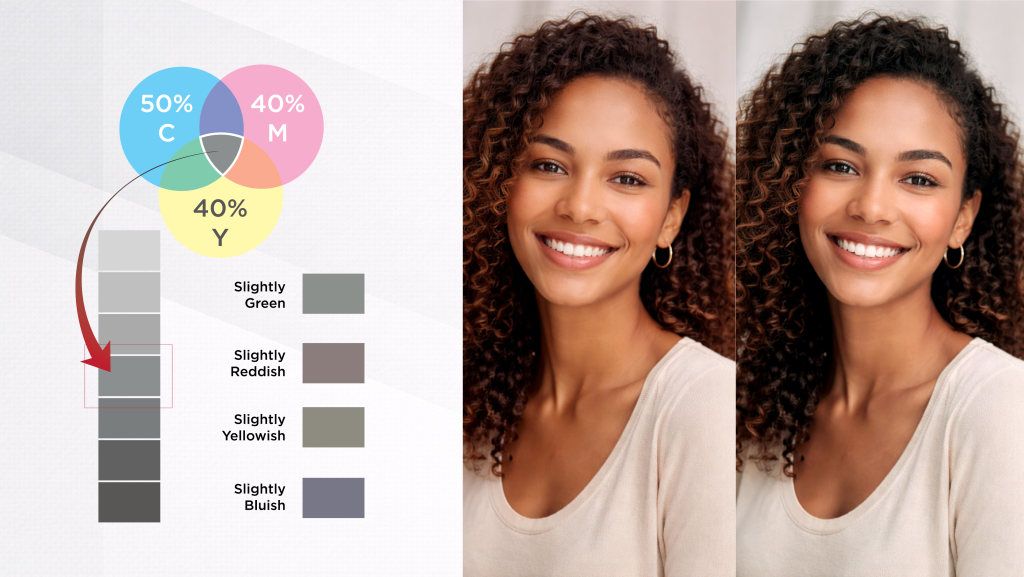
In CMYK printing, grey is usually created by combining Cyan, Magenta, and Yellow in carefully balanced percentages. A typical mid-tone grey might look like this:
A Standard Grey Formula
50% Cyan · 40% Magenta · 40% Yellow — balanced precisely to produce a visually neutral tone.
The Challenge
If even one ink deviates slightly — by as little as 3–5% — the grey shifts visibly and the entire colour balance is disrupted.
When grey shifts, it can become:
|
|
|
|
To the human eye, grey shifts are extremely noticeable. Humans are highly sensitive to neutrality — even a tiny colour cast reads as “something is wrong.”
Ink Is Not Perfect
Printing inks are not chemically identical from batch to batch. Each ink has its own behaviour, and small differences between batches can cause measurable colour drift.
Each ink also varies in:
- Slight pigment variation between manufacturing batches
- Different density characteristics affecting tone reproduction
- Different drying behaviour on coated and uncoated substrates
- Different dot gain properties depending on paper absorption
If these small deviations are not actively compensated, neutral tones drift — and the drift compounds across every page of the job.
Why Digital Printing Struggles with Grey
Toner-based digital printers often struggle with neutral grey reproduction. Unlike offset printing, digital systems face additional instability factors that make consistent grey particularly difficult to achieve.
Banding in Grey Backgrounds
Visible horizontal or vertical bands appear in large grey fields, caused by uneven toner distribution across the drum.
CMY Grey Instability
Many digital systems simulate grey using 3-colour CMY builds instead of black-only (K), creating an inherently less stable output.
Density Fluctuations
Toner density can vary across the width of a sheet, causing uneven tone distribution in backgrounds and gradients.
Green or Magenta Drift
Slight shifts toward green or magenta are a common digital printing artefact that clients often notice without being able to name the cause.
At Printec, digital workflows are calibrated separately from offset workflows to maintain grey neutrality across both production environments. Without proper profiling and tonal adjustment, CMY grey builds produce visible inconsistency.
Why Grey Matters in Real Projects
Grey is not a background detail — it is a structural element of professional design. It appears across virtually every category of print production:
Corporate Backgrounds
Annual reports, presentations, and branded stationery all depend on stable grey tones.
Minimalist Designs
When grey is the dominant visual element, any shift in neutrality is immediately visible.
Photography Shadows
Shadow detail in photography relies on stable grey — a drift affects the entire mood of the image.
Architectural Images
Stone, concrete, and steel all require accurate grey reproduction to look authentic in print.
Exhibition & Museum Panels
Large-format display graphics with grey fields reveal even tiny inconsistencies at viewing distance.
Corporate Reports
Data-heavy documents with grey tables, borders, and tonal backgrounds require precise control.
If grey shifts, the entire design looks unprofessional. Even skin tones in photography are highly dependent on stable grey balance — when grey drifts, skin tones look unnatural, even if the client cannot explain exactly what feels wrong.
How Printec Controls Grey Balance
Neutral grey control is not accidental. It requires structured management at every stage of the production process. At Printec Solutions Co. WLL, we apply a systematic approach:
Press Calibration
Ink density is standardised before production begins. Calibration targets are measured and adjusted to ensure consistent ink laydown across every press run.
Gray Balance Monitoring
Test prints are evaluated under proper D50 standard lighting for visual neutrality. Any colour cast is identified and compensated before the full run proceeds.
Mid-Tone Compensation
Small tonal adjustments are made in the pre-press stage to compensate for known ink bias in the CMY channel, preserving neutrality across the tonal range.
Dot Gain Correction
Mid-tones are the most affected by dot gain expansion. These values are carefully controlled in the ICC profile and press setup to prevent tonal darkening.
ICC Profile Optimisation
Device profiles are refined specifically to preserve neutral tone reproduction — not just optimised for overall colour accuracy. Grey balance is validated as a separate criterion.
The Result
Every print job from Printec produces grey that is visually neutral, consistent across runs, and stable across different substrates and output technologies.
Grey and Overall Colour Stability
In professional colour management, grey balance is not just one quality criterion among many — it is often used as the primary indicator of overall system health. When grey is stable, it means:
Ink Densities Are Controlled
Consistent ink laydown is confirmed — the press is behaving predictably across the entire sheet.
Tonal Curves Are Balanced
Highlight-to-shadow gradients are reproducing smoothly and naturally, without tonal distortion.
Dot Gain Is Compensated
Mid-tone expansion is predicted and corrected, preserving the intended tone structure of every file.
Colour Profiling Is Working
ICC profiles are accurately representing device behaviour and correcting for ink characteristics.
In advanced colour management methodologies such as G7 calibration practices, grey balance is central to achieving visual consistency across all output devices. Grey neutrality is not a cosmetic standard — it is a systems health indicator.
Why Small Deviations Become Big Problems
A 5% ink imbalance may sound insignificant in technical terms. Visually, its consequences are far-reaching:
Background Tone Shifts
An entire background field changes apparent colour — what was designed as cool neutral grey can print as warm or greenish grey.
Brand Colour Perception Changes
The perceived warmth or coolness of surrounding brand colours is altered by the grey environment they sit against.
Photography Feels Wrong
Images that looked natural on screen take on a colour cast in print, affecting skin tones, skies, and architectural photography.
Material Mismatch
Brochures, exhibition panels, and signage that should match each other appear to be different shades when placed side by side.
Clients may not know the technical reason — but they will notice something “feels off.” Professional grey control prevents that from ever happening.
Grey Across Multiple Technologies
In large-scale projects — events, museum installations, corporate exhibitions, brand environments — grey must match consistently across every output technology involved in the project.
Offset Printing
Highest achievable colour precision. Grey balance is managed through ink density control and ICC profiles.
Digital Printing
Requires separate tonal calibration. CMY grey builds are adjusted or replaced with K-only grey where stability is critical.
Latex Printing
Used for large-format display graphics. Grey is particularly prone to hue shift on fabric and synthetic media.
UV Printing
Applied to rigid substrates and signage. Ink curing behaviour affects dot gain and must be compensated for grey neutrality.
Fabric Printing
Event backdrops and exhibition stands. Fibre absorption characteristics alter tonal behaviour significantly.
Painted Signage
Environmental graphics matched to printed references. Colour formulation is guided by spectrophotometer measurement.
Matching grey across these technologies requires cross-device balancing — not just calibrating one machine in isolation. At Printec, visual neutrality is validated across all processes involved in a project, ensuring a unified brand appearance regardless of output method.
The Professional Difference
The difference between amateur and professional printing is not always visible in saturated colours. It is most clearly revealed in grey.
This is why professional printing looks clean, refined, and stable — not just on the first sheet of a run, but on the last sheet, and across every material in the campaign.
Final Thought
Neutral grey may look simple.
It is one of the most sensitive indicators of professional colour control.
If grey is accurate — images look natural, skin tones look realistic, backgrounds look clean, and brand identity remains stable across every printed surface.
At Printec Solutions Co. WLL, grey balance is not a by-product of our process.
It is a controlled outcome.
Ready to Elevate Your Brand’s Print Quality?
Don’t leave your brand’s visual integrity to chance. Professional grey control is just one part of what we bring to every project.
Partner with Printec Solutions Co. WLL for printing that delivers:
Accurate Colour Reproduction
Ensuring your colours are vibrant and true to your brand, every time.
Uncompromising Quality
From design to delivery, we maintain the highest production standards.
Expert Consultation
Benefit from our 20+ years of experience in printing and colour science.
Discussion
Share your thoughts on this article. Sign in with Google to join the conversation.
Comments are currently closed for this article.